
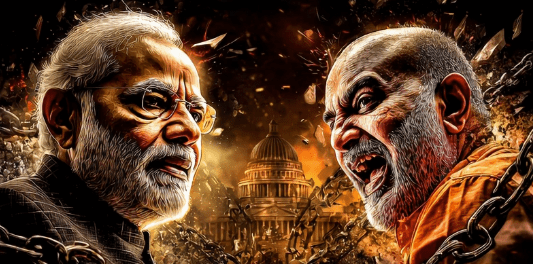
When the Sohrabuddin Sheikh encounter case first shook Gujarat in the mid‑2000s, few imagined it would one day sit at the intersection of power, policing, and national politics. The Amit Shah Sohrabuddin encounter case started as a story of alleged fake encounters and ended with every single accused walking free because the court said there was not enough evidence to convict them. Many citizens now ask: after Narendra Modi became Prime Minister in May 2014, how did Amit Shah, his close political ally, get discharged so quickly from such a high‑profile criminal case?
What Was the Sohrabuddin Encounter Case About?
On 26 November 2005, Gujarat Police shot and killed Sohrabuddin Sheikh, describing it as an “encounter killing” of a wanted criminal. His wife, Kauser Bi, was picked up with him and later disappeared; she was allegedly murdered and her body burnt near Ilol in Gujarat. Tulsiram Prajapati, an associate who was a key witness, was also killed in another police encounter near Ambaji at the Gujarat–Rajasthan border in December 2006. Sohrabuddin’s brother wrote to the Chief Justice of India alleging that this was not a genuine encounter but a planned custodial killing with police involvement.
The Supreme Court directed Gujarat’s CID to investigate. Later, the court transferred the probe to the CBI and even shifted the trial out of Gujarat to Mumbai, saying this would help ensure a fair process. Over time, multiple senior IPS officers were arrested, and a detailed chargesheet was filed. The narrative built by investigators was that a network of policemen and officials had allegedly conspired to eliminate Sohrabuddin and Prajapati in staged encounters.
Why Was Amit Shah Named as an Accused?
The Amit Shah Sohrabuddin encounter case took a dramatic turn in July 2010, when the CBI chargesheeted and arrested Amit Shah, then Minister of State for Home in the Gujarat government. Investigators alleged that as the political head of the state’s home department, he was part of a wider conspiracy and had used state machinery to facilitate the encounters and cover up the killings. Shah denied all allegations and called the case politically motivated.
Because Shah was seen as Narendra Modi’s closest political aide in Gujarat, his arrest immediately became a national political flashpoint. The case became not just about one alleged fake encounter, but about accountability in a state that was rapidly rising to dominate national politics.
Judge Transfers, Political Rise, and Shah’s Discharge
The timeline raises questions that many ordinary citizens still struggle with. The Supreme Court had specifically said that one judge should handle the entire trial to maintain continuity. The first CBI judge in Mumbai, J T Utpat, reportedly pressed for Amit Shah’s personal appearance in court. He was suddenly transferred in June 2014, soon after Modi became Prime Minister.
Judge B H Loya then took over the Amit Shah Sohrabuddin encounter case. He too is reported to have insisted that Shah should appear in person. In December 2014, Judge Loya died in Nagpur under circumstances that later prompted his own family members to voice doubts in media interviews. The Supreme Court ultimately ruled that his death was due to natural causes and refused to order a fresh probe. After Judge Loya’s death, Judge M B Gosavi took charge, and in December 2014 he discharged Amit Shah, stating there was no prosecutable evidence against him.
Shah was thus freed even before the full trial against the remaining accused had concluded. Later, when Sohrabuddin’s brother and activist Harsh Mander tried to legally challenge the discharge, courts dismissed their petitions on the ground that they did not have the required “locus standi” to appeal against Shah’s relief.
Hostile Witnesses and the Final Acquittals
When the main trial finally began in November 2017 under Special CBI Judge S J Sharma, 22 policemen and officials remained as accused; Shah was no longer part of the case. Out of 210 prosecution witnesses, 92 turned hostile. Many changed or withdrew their earlier statements. In December 2018, the special court acquitted all 22 remaining accused, saying the prosecution had failed to prove the alleged conspiracy and there was not enough evidence to convict anyone.
Legally, this meant the Amit Shah Sohrabuddin encounter case ended with a complete collapse of the prosecution’s narrative. The court’s verdict must be respected: it held that there was no sufficient proof to find Shah or any of the other accused guilty. At the same time, for many members of the public, the pattern of transfers, deaths, hostile witnesses and timing continues to provoke doubt and discomfort, even if the legal record is clear.
How Is This Possible in a Criminal Case?
Under criminal procedure, the burden of proof lies on the prosecution, and an accused has to be acquitted if guilt is not proved beyond reasonable doubt. When witnesses turn hostile, records are incomplete, or the chain of evidence breaks, judges are bound to give the benefit of doubt to the accused. That is exactly what happened in the Amit Shah Sohrabuddin encounter case and the related trials: the court said the evidence was too weak and inconsistent to sustain convictions.
But the deeper question many Indians are asking is different. How did so many key witnesses reverse their positions? Why did the judge who first pushed for Shah’s appearance get replaced, and why did Judge Loya die in the middle of such a sensitive case? Why did every institutional development—from transfers, to witness hostility, to final acquittals—seem to move in one direction, favouring the most powerful accused?
What Do You Think?
In the end, the law has spoken: Amit Shah stands discharged, and all other accused have been acquitted. Yet the Amit Shah Sohrabuddin encounter case remains, in public memory, a symbol of how power, policing, and justice can intersect in ways that are hard for ordinary people to fully trust or understand.
So the question now passes to you, the reader:
In a democracy, when such a high‑profile case ends with every powerful accused walking free, do you feel reassured by the courts’ insistence on strict evidence—or shaken by how fragile truth can seem when politics and power are involved?



 Aaj Ki Janta
Leave a comment