
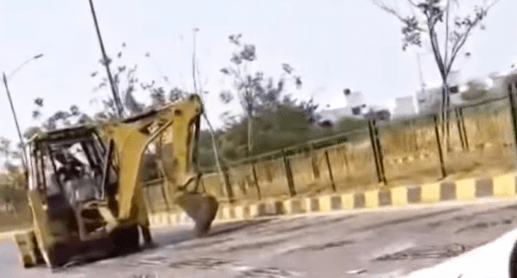
A viral video from Nava Raipur (NRD) has ignited a fierce debate about public accountability and infrastructure governance. The footage shows heavy JCB machinery tearing up what residents claim was a perfectly functional road, raising serious questions about how taxpayer money is being spent.
What the Viral Video Shows
Within minutes, powerful excavators reduced the road to rubble. For residents who used the stretch daily, the sight was both shocking and infuriating. The road appeared to have no visible damage, yet it met a swift, destructive end.
Local claims suggest the demolition was orchestrated to justify issuing fresh tenders for reconstruction. However, authorities have yet to release any detailed explanation, and this silence has only deepened public mistrust.
Residents Demand Answers
“We drove on this road every single day without any issues,” said one frustrated resident. “Now suddenly it’s being destroyed. Who ordered this? Why?”
Moreover, municipal officials insist all roadwork follows sanctioned procedures. Nevertheless, no work order or technical clarification has been made public so far. Consequently, anger continues to build as demands for transparency grow louder by the hour.
The Other Side: Technical Perspective
Interestingly, infrastructure experts offer a different angle. They point out that in many projects, the top asphalt layer is intentionally removed for specific reasons:
- To prepare for fresh resurfacing
- To fix underlying quality issues
- To facilitate utility work beneath the road
Furthermore, the JCB operator reportedly stated he was following official orders, not acting independently. Therefore, jumping to conclusions based solely on viral visuals may be premature.
A Pattern of Mistrust
This incident doesn’t exist in isolation. Across cities, similar allegations of tender manipulation and unnecessary rebuilding have eroded confidence in civic governance. When functional roads are demolished while genuinely damaged ones remain ignored, citizens naturally ask: who benefits from this cycle?
Additionally, good governance isn’t just about building new assets—it’s about preserving existing ones responsibly.
What Happens Next?
Until clear answers emerge, the image of a JCB crushing what appeared to be a serviceable road will remain a powerful metaphor. It represents how casually public trust can sometimes be demolished.
If the road was genuinely unsafe, authorities must show proof. If it wasn’t, accountability must follow.
The Need for Transparency
Currently, the Nava Raipur road demolition controversy lands at a sensitive moment. Public patience with opaque governance is wearing thin. Citizens deserve straightforward answers about:
- The technical justification for demolition
- Official work orders and approvals
- Future reconstruction plans and costs
- How such decisions are made
Conclusion
While viral videos can spark important conversations, they shouldn’t replace verified facts. Nevertheless, authorities have a responsibility to address public concerns promptly and transparently.
The Nava Raipur road demolition has become more than a local issue—it’s a test of civic accountability. Whether this proves to be legitimate infrastructure work or wasteful expenditure depends entirely on what officials reveal in coming days.
For now, one thing remains clear: when public money is involved, silence is never the answer. Transparency is.
What are your thoughts on this controversy? Should authorities be more proactive in explaining infrastructure decisions before work begins?



 Aaj Ki Janta
Leave a comment